The State of Medical Tourism 2026
What 500 Medical Tourism Clinics and the Latest International Research Reveal About Converting More Enquiries Into Booked Treatments
International patient demand is growing.
Competition is growing even faster.
CommCoreAI reviewed 500 medical tourism clinics and analysed the latest international research into patient behaviour, artificial intelligence and healthcare marketing.
The result is The State of Medical Tourism 2026 - an executive publication created for clinic owners, medical tourism directors, patient managers and healthcare leaders responsible for international patient growth.
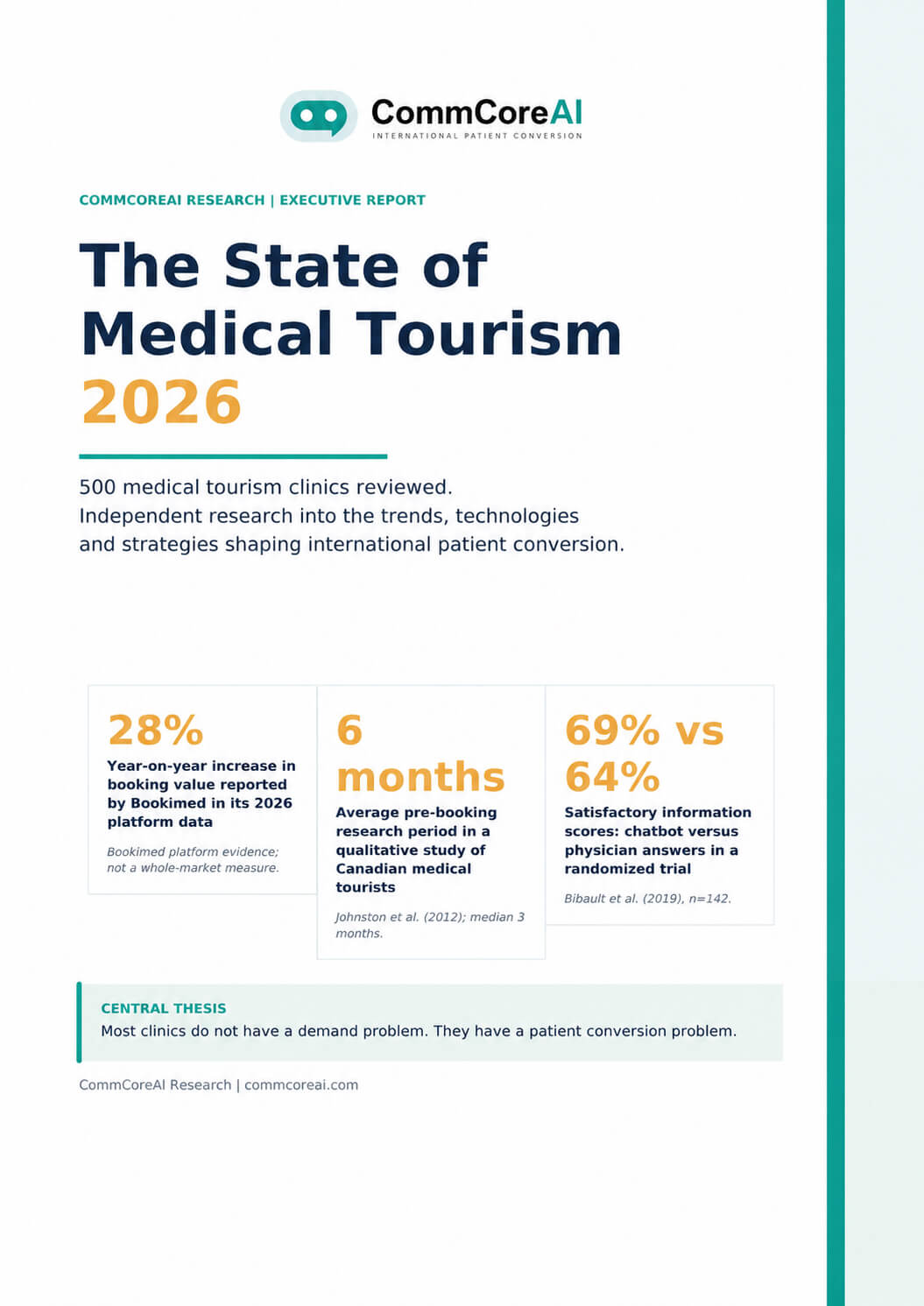
Research Highlights
Medical tourism clinics reviewed
Increase in booking value reported by Bookimed
Average patient research period before booking
Higher conversion for 5-minute responses
500 medical tourism clinics reviewed.
Independent research into the trends, technologies and strategies shaping international patient conversion.
Research informed by internationally recognised sources
Executive Overview
Executive Summary
Why this report exists
Medical tourism is entering its steepest growth phase in more than a decade. Global Market Insights forecasts the global medical tourism market to grow from $34 billion in 2025 to $126 billion by 2035, representing a strong compound annual growth rate. At the same time, patient behaviour is being reshaped by generative AI, with research, comparison and first contact increasingly taking place inside conversational channels rather than static websites.
CommCoreAI’s independent audit of 500 medical tourism clinics found that the market is slower than many of its international peers to adopt these technologies. Nine out of ten clinics reviewed operated with no conversational assistant, no multilingual real-time response layer, and no structured follow-up beyond a single reply. The marketing spend is world-class. The conversion infrastructure is not.
The wider evidence base tells a remarkably consistent story. Peer-reviewed research into chatbot performance, lead response speed, personalisation and multilingual trust all points in the same direction.
The clinics outperforming their competitors are not the ones spending the most on advertising. They are the clinics that respond faster, communicate in the patient’s own language, and maintain continuity throughout a decision journey that often lasts three to six months.
Key Findings
Projected value of the global medical tourism market by 2035.
Of the 500 clinics reviewed had no conversational assistant or structured patient engagement.
Higher conversion rates have been associated with AI-powered communication systems in tourism services.
The Central Thesis
Most clinics do not have a demand problem.
They have a patient conversion problem.
The demand is coming.
The central purpose of this report is to explore what clinics must do to capture a greater share of that demand by improving response speed, multilingual communication, personalisation and AI-supported follow-up, turning more international enquiries into booked consultations and completed treatments.
Marketing generates enquiries. Patient conversion generates revenue.
As competition intensifies, the clinics that outperform their peers will not necessarily attract more enquiries—they will consistently convert more of the enquiries they already receive.
What Leading Clinics Should Do Next
- Measure your average response time across every patient channel.
- Review what happens to enquiries received outside business hours.
- Assess whether every international patient receives support in their preferred language.
- Identify where enquiries drop out before a consultation is booked.
- Begin measuring patient conversion, not just enquiry volume.
Executive Overview
Market Context
A Growing Market Creates a Larger Conversion Prize
Independent market evidence shows rising demand, rising competition and greater pressure on clinic conversion systems.
Key Market Indicators
Estimated size of the global medical tourism market in 2025.
Global Market Insights commercial forecast.
Forecast market size by 2035.
Strong CAGR
International patient enquiries reported by Bookimed in its latest annual platform data.
Year-on-year increase in booking value reported by Bookimed.
Global Medical Tourism Market
Market Analysis
The market opportunity is real, but so is the competitive pressure.
Global Market Insights expects the global medical tourism market to more than quadruple between 2025 and 2035.
Bookimed’s latest platform report adds a demand-side view, reporting more than 170,000 patient enquiries, a 28% increase in booking value year on year.
This growth does not remove the conversion challenge. It magnifies it.
- More patients mean more conversations across WhatsApp, Instagram, website chat, email and marketplace platforms.
- More providers mean patients can compare multiple clinics within minutes.
- More marketing investment means every unanswered or poorly managed enquiry carries a higher acquisition cost.
Growth rewards clinics that convert enquiries efficiently—not simply those that generate the highest volume of enquiries.
Is your clinic’s conversion capacity growing as quickly as its enquiry volume?
What Leading Clinics Should Do Next
- Measure enquiry-to-consultation conversion rather than enquiry volume alone.
- Review how patients move between your website, WhatsApp and social channels.
- Identify where patients stop engaging before booking a consultation.
- Benchmark conversion performance alongside marketing performance.
Executive Overview
Five Conclusions
Five Conclusions with Direct Commercial Implications
The strongest findings from the research, translated into leadership decisions.
Conversion Is a Strategic Growth Lever
Research has associated generative AI communication with 35.6% higher conversion rates in tourism services. Real-time assistance, personalisation and automated follow-up can materially improve conversion, although results depend on implementation quality.
The Decision Window Is Longer Than Most Clinics Think
International patients rarely make immediate decisions. Research suggests the journey from first researching treatment to contacting a provider with booking intent often spans three to six months. Clinics need structured, ongoing follow-up—not just one or two messages.
Routine Information Can Be Delivered Effectively by Conversational AI
Clinical research has shown conversational AI can successfully answer routine patient questions while maintaining high satisfaction levels. This allows coordinators to focus on complex conversations where empathy, judgement and experience matter most.
Language and Continuity Build Trust
International patients value clear communication throughout their journey. Multilingual support is about far more than translation—it requires context, continuity and confidence that every interaction moves the patient closer to treatment.
The Future Is Human + AI
The strongest operating model is not AI replacing coordinators. AI provides speed, availability, qualification and structured follow-up. Coordinators retain ownership of relationships, sensitive conversations and clinical judgement.
Research Spotlight
AI-Powered Communication Is Emerging as a Major Driver of Medical Tourism Conversion
A 2025 study published in the Journal of Marketing found AI-powered communication technologies—including intelligent chatbots, multilingual support and automated follow-up—to be among the strongest contributors to attracting and converting international health tourists. Clinics adopting these technologies reported higher patient engagement, stronger conversion and a measurable competitive advantage.
Source: Yorulmaz, M. (2026). "The strategic impact of artificial intelligence on medical tourism marketing." Journal of Marketing, 10(3), 107–114. DOI: 10.30685/tujom.v10i3.220
Higher conversion rates achieved by clinics using generative AI-based communication systems in tourism and travel services
The question is no longer whether AI has a role in patient conversion. The question is how clinics implement it safely, strategically and alongside their existing teams.
What Leading Clinics Should Do Next
- Review where repetitive coordinator tasks can be automated.
- Build structured follow-up across the full patient decision journey.
- Ensure multilingual communication maintains context—not just translation.
- Treat AI as a conversion layer that supports people, rather than replacing them.
CommCoreAI Market Audit 2026
What We Found After Reviewing 500 Medical Tourism Clinics
Original CommCoreAI market research on website engagement, lead capture and the conversion gap.
The Question
How effectively are clinics converting the website traffic they already attract?
Key Findings
Medical tourism clinic websites reviewed
Dental, hair transplant and cosmetic surgery providers.
Had no chatbot or conversational website assistant
No real-time mechanism to engage visitors before they left.
Estimated monthly organic search visits for some clinics
Ahrefs estimates, not first-party analytics.
A Significant Gap Between Visibility and Engagement
Alongside the academic and industry evidence in this report, CommCoreAI conducted an independent digital audit of 500 medical tourism clinic websites.
Each site was reviewed for:
- Chatbot availability
- Live or conversational engagement
- Lead-capture routes
- Multilingual accessibility
- WhatsApp implementation
- Estimated monthly organic search traffic using Ahrefs.
The audit found that nine in ten clinics had no chatbot or conversational assistant engaging people on the website.
Many were attracting substantial search visibility, yet offered no proactive conversation, no treatment qualification and no structured way to capture a visitor who left without submitting a form or starting a message.
Many clinics have solved the challenge of attracting visitors.
Far fewer have built a system to engage and capture them.
Understanding Patient Conversion
The Modern International Patient
Today’s international patient behaves very differently from a decade ago.
Patients no longer rely on a single clinic recommendation or website.
Instead, they research extensively, compare providers, ask questions across multiple channels and often engage with several clinics before deciding where to receive treatment.
For many clinics, the greatest challenge is no longer generating enquiries—it’s remaining part of the patient’s decision-making process until they are ready to book.
How Patients Research Today
The New Reality
International patients are no longer comparing treatments alone.
They are comparing:
The clinic that creates trust earliest often controls the remainder of the conversation.
Patients don’t choose the first clinic they find. They often choose the clinic that guides them best throughout their decision journey.
What Leading Clinics Should Do Next
- Experience your own enquiry process as if you were an international patient.
- Test every communication channel outside office hours.
- Review whether your clinic delivers a consistent experience across every touchpoint.
- Identify where patients are likely to disengage before requesting a consultation.
Understanding Patient Conversion
Decision Journey™
THE NEW PATIENT REALITY
The old lead-response model is obsolete: patients research independently, compare across channels and expect continuity before they ever commit.
The Modern International Patient Journey
Research Finding
Johnston et al. found wide variation in how long patients took to decide, from one week to ten years. Excluding the ten-year outlier, the average pre-contact research period was six months, with a median of three months.
During this period, patients researched destinations, assessed risk, contacted providers and spoke with other medical tourists before making a decision.
Implementation Action
Design follow-up for a multi-month decision cycle.
One or two follow-up attempts are not a conversion strategy.
FRAMEWORK 01
The International Patient Decision Journey™
Trust accumulates across repeated interactions — not in a single reply.
The Journey
AI Leads
- 24/7 response across all channels
- Preferred-language communication
- Routine information delivery
- Structured qualification
- Consistent follow-up
- Dormant lead reactivation
Human Leads
- Accountable clinical judgement
- Complex reassurance
- Safeguarding decisions
- Treatment recommendations
- Consultation and closing
- Relationship ownership
Design Principle
AI supports continuity across the journey. The clinic team owns the patient relationship.
Understanding Patient Conversion
Patient Leakage Funnel™
Where international patient enquiries are won — or quietly lost.
Commercial Implication
A clinic that measures only leads and bookings cannot see where revenue is being lost.
The funnel should be measured at every transition:
- Enquiry → Meaningful response
- Meaningful response → Active conversation
- Active conversation → Qualification
- Qualification → Consultation
- Consultation → Booked treatment
Why Clinics Lose Patients
Response Speed
FINDING 01
The first meaningful reply determines whether a clinic earns the right to continue the conversation.
Key Evidence
Enquiries answered within the first five minutes have been reported to convert at up to 8× the rate of later responses.
AI-supported availability is repeatedly identified as a core value in medical tourism and healthcare communication research.
Median WhatsApp response time recorded during CommCoreAI’s 2026 audit of 500 medical tourism clinics.
Why Speed Matters Commercially
International patients usually contact several clinics while actively comparing treatment options.
The first clinic to provide a useful, relevant response begins reducing uncertainty first.
The research does not support speed as a substitute for quality. It supports designing responses that are both immediate and meaningful.
What To Measure
Average response time alone is not enough. Leadership teams should also measure:
- Median response time
- 90th percentile response time
- Response by channel
- Response by time of day
Side-by-Side Comparison
A message saying “We’ll contact you tomorrow” is not equivalent to a response that identifies treatment interest.
Answers the patient’s first question and creates a clear next step.
Executive Takeaway
Patients rarely choose a clinic based on a single interaction.
Trust is built through repeated, timely and relevant communication.
Recommended action: Review your website outside office hours. Can an international patient receive meaningful answers immediately? If not, your clinic may be losing patients before they ever become enquiries.
Why Clinics Lose Patients
Language, Clarity & Trust
FINDING 02
Multilingual support is not a decorative feature. It is part of access, confidence and perceived quality.
Research Finding
A systematic review of language barriers in healthcare found effects on communication quality, patient safety, satisfaction and access.
Medical tourism experience reviews similarly identify language and coordination as recurring points of anxiety.
Commercial Implication
Patients build confidence through repeated signals:
A delayed translated response is still a delayed response. If a patient must wait for a specific coordinator, the clinic loses the commercial value of multilingual capability at the exact moment trust is being formed.
Six Priority Languages — One Continuous Patient Context
Our research identifies these six languages as the most frequently used by international patients. However, the CommCoreAI system is built to communicate fluently in over 100 languages.
Surgery is a serious decision.
If a patient cannot be sure their request is fully understood, confidence collapses before care is even discussed.
A single misunderstanding about a procedure, recovery or expectations can permanently damage trust. Clear communication in the patient’s own language is not a courtesy—it is a prerequisite for confidence.
Language is not a translation feature. It is trust infrastructure.
Patients evaluating a clinic in a second language rely on clarity to feel safe.
Recommended action: Test how quickly a non-English enquiry receives a meaningful reply on your busiest channel. If the answer depends on which coordinator is available, you have a conversion risk—not a language capability.
Why Clinics Lose Patients
Personalisation & Follow-up
FINDING 03
Patients need relevant continuity across a long, non-linear decision process.
Decision Period
Average pre-booking research period in the Canadian qualitative study.
(Median: 3 months)
Booking to Surgery
Average period from booking to surgery.
(Median: 2 months)
Trust Accumulation
Trust is built through repeated information, comparison and reassurance — not minutes.
The Patient Decision Period
Treatment discovery and destination comparison.
Contacting clinics and receiving first quotes.
Consultation, deposit and travel logistics.
What Personalisation Actually Means
Personalisation in medical tourism should not mean guessing sensitive attributes or producing artificial familiarity. It should mean using information the patient has already provided:
Where Continuity Breaks Down
Usually handled well by most clinics.
Continuity stops after the first or second interaction. No structured follow-up exists.
The evidence supports a structured, stage-based follow-up model, rather than a short burst of generic reminders.
Executive Takeaway
Interested patients rarely say no. They go quiet.
A structured, relevant follow-up sequence is the difference between a lost enquiry and a booked consultation.
Recommended action: Review how many historic enquiries your clinic has never re-engaged. Even a small proportion of reactivated dormant leads can outperform an entire month of new advertising spend.
Why Clinics Lose Patients
Conversational AI Evidence
FINDING 04
Conversational AI can deliver routine information at a quality patients rate as acceptable — when it is designed and evaluated properly.
Bibault et al. Randomized Noninferiority Trial
142 women with breast cancer were randomised to receive answers from either:
- A conversational AI chatbot
- A multidisciplinary physician group
The study assessed perceived information quality using an adapted EORTC QLQ-INFO25 instrument.
Interpretation
The trial found the chatbot’s answers to be noninferior to physician answers for overall perceived information quality.
This does not mean a chatbot replaces a physician or patient coordinator.
It demonstrates that a well-designed conversational system can handle routine informational questions effectively, allowing clinicians and coordinators to focus on conversations requiring judgement, empathy and accountability.
The Implementation Lesson
Performance depends on scope and governance.
A patient conversion system should clearly understand:
- What it is authorised to answer
- When clarification is required
- When a coordinator should take over
- When clinical escalation is necessary
Quality assurance, approved knowledge and auditability are fundamental to safe implementation—not optional extras.
Why Clinics Lose Patients
Generic AI Chatbots
FINDING 06
Why Generic AI Chatbots Can Reduce Conversion
The risk isn’t using AI. The risk is using AI that hasn’t been trained for international patient conversion.
Generic AI Chatbots
- Trained primarily on website content
- Generic responses
- Limited objection handling
- Weak context retention
- Poor or undefined handover
- Little understanding of the clinic’s patient journey
Clinic-Trained Patient Conversion System
- Four-week onboarding process
- Approved clinic knowledge base
- Treatment and package expertise
- Objection-handling and conversion training
- Multilingual context retention
- Structured warm handover to coordinators
- Clinical and safeguarding escalation rules
COMMCOREAI FOUR-WEEK CLINIC-SPECIFIC ONBOARDING
Treatments, surgeons, pricing logic, inclusions, exclusions, policies and escalation boundaries.
Approved knowledge base, terminology, tone, languages, empathy and reassurance pathways.
Qualification, objection handling, follow-up, closing techniques and handover triggers.
Scenario testing, red-team review, clinical approval, coordinator training and QA launch.
The agent is trained to be an expert in the clinic's approved offering, patient journey and commercial information — never an expert in clinical medicine. Diagnosis, assessment, treatment recommendations and medical advice remain with qualified clinic staff.
CommCoreAI Research | International Patient Conversion Report 2026 17
LEADERSHIP TEST
Would you allow a new coordinator to speak to patients after reading only your website? If not, the same standard should apply to AI.
Commercial Implication
A fast response only creates value when it is:
Generic answers may create the appearance of responsiveness while failing to build trust or move the conversation forward.
CommCoreAI Application
CommCoreAI is designed as a patient conversion system, not simply a chatbot. Its purpose is to support patients through qualification, multilingual communication, objection handling, structured follow-up and warm handover, while ensuring clinical decisions remain with the clinic team.
Research & Frameworks
Data, Reviews & Predictive Insight
FINDING 05
Patient feedback and conversation data reveal where trust breaks down — and what leadership must fix.
Patient Dissatisfaction Data – 2026
Analysis of 365 negative medical tourism reviews published in the Journal of Hospitality and Tourism Insights identified four recurring themes:
Poor Medical Service Quality
Treatment concerns and unmet clinical expectations.
Financial Problems
Unexpected costs and pricing disputes.
Administrative Failures
Coordination and communication breakdowns.
Inadequate Aftercare
Patients feeling abandoned after treatment.
Review Analytics
Text mining can group recurring complaint themes and satisfaction drivers across:
- Public reviews
- Patient surveys
- Support messages
Predictive Follow-up
No-show studies show structured data can identify patients who may benefit from:
- Targeted reminders
- Additional reassurance
- Human intervention
Conversation Intelligence
Clinic leaders can use enquiry data to identify:
- Common objections
- Drop-off points
- Market differences
- Dormant lead opportunities
Conversion cannot be separated from delivery.
Administrative failures, unclear costs and weak aftercare damage reviews, referrals and future conversion.
Standardise journey stages, loss reasons and complaint themes, assigning ownership and accountability to every recurring friction point.
Recommended Action
Review the last 30 negative reviews for your clinic—or a direct competitor.
Count how many relate to:
The answer often reveals where your greatest commercial improvement opportunity exists.
Research & Frameworks
The Economics of Conversion Improvement
FINDING 07
Why a small increase in conversion can outperform a large increase in lead volume.
Illustrative Clinic Scenario
The Lead Volume Alternative
At an 8% conversion rate, generating 20 additional consultations would require approximately 250 extra enquiries.
Improving conversion from 8% to 12% produces the same consultation gain without increasing lead volume.
Important
This is an illustrative model, not a guaranteed result.
The Patient Leakage Audit uses each clinic’s actual enquiry volume, conversion stages and treatment economics.
Small improvements in conversion can eliminate the need for significantly more marketing spend.
Research & Frameworks
Coordinator Value Curve™
FRAMEWORK 03
Human + AI: Coordinator Value Curve™
The highest-value coordinators spend less time answering routine questions and more time building patient confidence.
The Coordinator Value Curve
- Repetitive FAQs
- Appointment availability
- Language translation
- Routine follow-up
- Building trust
- Clinical reassurance
- Managing objections
- Treatment decisions
Core Principle
AI should reduce repetitive administrative workload.
Coordinators should spend more time where human judgement, empathy and relationship-building create the greatest value for both the patient and the clinic.
Commercial Implication
As enquiry volumes increase, simply adding more coordinators becomes increasingly difficult to scale.
Supporting coordinators with structured AI enables teams to focus on the conversations that have the greatest impact on consultation and treatment conversion.
Implementation Action
Review how your coordinators currently spend their day. Identify:
The objective is not to replace coordinators. The objective is to increase the time they spend creating value for patients.
Research & Frameworks
Five Pillars™
FRAMEWORK 04
Five Pillars of International Patient Conversion™
A complete operating model linking research, strategy and patient conversion.
Click the pillars below to explore the operational foundations of international patient conversion.
Risk
Competitors establish trust before your team has responded.
Research Finding
Patients who receive timely, meaningful responses are significantly more likely to continue their journey with a clinic.
Recommended Action
Establish response time standards across website chat, WhatsApp, social media and enquiry forms. Measure meaningful response times, not simply acknowledgements.
Outcome
More enquiries become active conversations and qualified consultations.
Research & Frameworks
AI-Augmented Journey™
FRAMEWORK 05
The AI-Augmented Patient Journey™
AI supports continuity. The clinic team owns the patient relationship.
Implementation
90-Day Roadmap
PLAYBOOK
Diagnose first. Deploy narrowly. Optimise from real conversations.
Click each phase to explore the implementation roadmap.
Core Activities
- Measure response times by channel and daypart.
- Map every enquiry source and handover.
- Audit follow-up depth and dormant leads.
- Identify common questions and objections.
- Define clinical and safeguarding escalation rules.
Deliverables
- Baseline dashboard
- Patient journey map
- KPI definitions
Governance
Every implementation should have clear ownership.
Implementation
Patient Conversion Assessment
DIAGNOSTIC
A quick self-assessment designed to expose where deeper audit work is needed.
Click the options below to see your score.
Can international patients receive a meaningful response within five minutes?
Can they receive the same level of response outside office hours?
Can every patient communicate immediately in their preferred language?
Does follow-up continue according to treatment interest and decision stage?
Can your team see every patient’s previous questions, concerns and interactions?
Are enquiry stages, next actions and loss reasons consistently recorded?
Can management identify where patients leave the journey?
Are coordinators protected from repetitive questions and manual follow-up?
Can enquiries be traced through to consultation, deposit and completed treatment?
Interpretation
Implementation
Measurement Framework
OPERATING SYSTEM
The Conversion Measurement Framework
The metrics required to manage patient conversion from enquiry to treatment.
First Response
- Median response time
- 90th percentile response time
- Response by channel
- Response by daypart
Engagement
- Meaningful response rate
- Reply rate
- Conversation depth
Qualification
- Qualified enquiry rate
- Completion of required information
Consultation
- Consultations booked
- Consultations attended
- Rescheduled consultations
Commercial
- Deposits received
- Treatments booked
- Revenue by source
- Revenue by market
Follow-up
- Sequence completion
- Reactivation rate
- Time to next action
Quality
- Escalation accuracy
- Content errors
- Coordinator overrides
Experience
- Patient satisfaction
- Complaint themes
- Review signals
Key Definitions
Meaningful Response Rate
The proportion of enquiries receiving a relevant answer together with a clear next step.
Sequence Completion
The proportion of patients who successfully reach the intended end of an approved follow-up journey.
Management Principle
A conversion system is only credible when leadership can trace an enquiry through every stage of the patient journey, identify exactly where it stopped, and connect operational improvements to consultation, treatment and commercial outcomes.
Implementation
Five Questions
BEFORE YOU FINISH READING
Five Questions Every Clinic Should Ask
Answer these honestly. The answers will tell you where your next commercial gain is hiding.
How many website visitors leave without contacting us?
How quickly do we respond outside office hours?
How many languages can we support immediately?
How many historic enquiries have never been re-engaged?
If we increased conversion by just 10%, what would that mean for our business?
Final Thought
The clinics that outperform over the next decade are unlikely to be those spending the most on advertising.
They will be the clinics that convert more of the demand they already generate.
Artificial intelligence is not the objective. Better patient conversion is.
Ready to Discover Your Biggest Conversion Opportunity?
Book your complimentary Patient Leakage Audit and identify where patients are being lost between enquiry and consultation.
The International Patient Conversion Score™
Get Your Patient Conversion ScoreDiscover your hidden conversion gaps in 60 seconds
Implementation
Patient Leakage Audit
PATIENT LEAKAGE AUDIT™
Discover where your clinic is losing international patients before they become booked consultations.
What Is The Patient Leakage Audit?
The Patient Leakage Audit™ is a structured review of your clinic’s international patient journey. It is designed to identify where enquiries are being lost between first contact and completed treatment, using the same frameworks presented throughout this report.
What We Review
- Website enquiry experience
- WhatsApp response process
- Social media conversations
- Follow-up strategy
- Multilingual patient experience
- Coordinator workflow
- AI readiness
- Patient journey measurement
- Conversion opportunities
What You’ll Receive
- A review of your current patient conversion process.
- Identification of the highest-priority leakage points.
- Practical recommendations based on the frameworks in this report.
- Clear next steps to improve enquiry-to-consultation conversion.
Who Is It For?
Closing Statement
Every clinic generates leakage.
The difference is that the highest-performing clinics know exactly where it occurs and have a structured plan to reduce it. The Patient Leakage Audit™ is designed to help you identify those opportunities before they become lost revenue.
Book Your Patient Leakage AuditDiscover where patients are being lost and what practical steps your clinic can take to improve international patient conversion.
Based on the research and frameworks presented throughout The State of Medical Tourism 2026
About CommCoreAI
About CommCoreAI
Research-Informed. Conversion-Focused.
CommCoreAI helps medical tourism clinics convert more international patient enquiries into booked consultations and completed treatments.
Every workflow, conversation and AI agent has been shaped by extensive research into international patient behaviour, healthcare communication and conversational AI, together with our independent review of 500 medical tourism clinic websites.
Rather than starting with AI and looking for a problem to solve, we started by understanding how international patients research, compare and choose clinics. Those findings became the foundation of the CommCoreAI platform.
What Makes CommCoreAI Different
CommCoreAI is purpose-built for international patient conversion. Our platform helps clinics:
- Engage patients 24/7 across website chat, WhatsApp, Instagram, Facebook Messenger and other supported channels.
- Communicate naturally in 100+ languages.
- Answer questions using the clinic’s approved knowledge base.
- Qualify patients and collect relevant information.
- Handle common objections and guide conversations towards the next step.
- Follow up consistently throughout the patient’s decision journey.
- Reactivate dormant enquiries already held within the clinic’s CRM.
- Provide warm handovers to patient coordinators with complete conversation history.
- Apply defined clinical escalation rules where human intervention is required.
- Deliver conversation analytics and reporting to identify conversion opportunities.
Built From Research. Designed For Results.
The frameworks presented throughout this publication—including the Patient Leakage Funnel™, International Patient Decision Journey™, Five Pillars of International Patient Conversion™ and AI-Augmented Patient Journey™—are not simply research models.
They are the principles used to design and continually improve the CommCoreAI platform, helping clinics respond faster, communicate more effectively and convert more of the international enquiries they already generate.
Continue The Conversation
Visit Our Website
Explore our platform, latest research and resources for medical tourism clinics.
Visit www.commcoreai.comBook a Complimentary Patient Leakage Audit™
Receive a personalised review of your clinic’s patient conversion journey and discover where enquiries may be leaking before they become booked consultations.
Book Your AuditOur Mission
To help medical tourism clinics maximise the value of every enquiry by combining evidence-based research with responsibly implemented AI that supports—not replaces—the human patient experience.
References
References & Notes
Medical Tourism & Patient Conversion Research
The evidence underpinning The State of Medical Tourism 2026.
This publication combines independent CommCoreAI research with peer-reviewed academic studies and recognised industry reports to ensure every recommendation is grounded in published evidence.
Peer-Reviewed Research
- Yorulmaz, M. (2026). The Strategic Impact of Artificial Intelligence on Medical Tourism Marketing.
- Karcıoğlu, U. B. (2025). The Impact of Artificial Intelligence on the Patient Journey in Medical Tourism.
- Johnston, R., Crooks, V. A., & Snyder, J. (2012). Decision-Making Processes of Canadian Medical Tourists.
- Xu, T. et al. (2020). Patients’ Experience in Medical Tourism.
- Ozan-Rafferty, M. E. et al. (2014). Internet Narratives by Health Travellers to Turkey.
- Khan, M. J. et al. International Patients’ Travel Decision-Making Process.
- Kim, S. et al. Critical Success Factors of Medical Tourism.
- Ahani, A. et al. (2021). Online Review Analysis in Medical Tourism.
- Nilashi, M. et al. Text Mining and Online Reviews in Medical Tourism.
- Chang et al. Medical Tourism Mobile App Adoption.
Industry Research
- Global Market Insights – Turkey Medical Tourism Market Size & Share (2026–2035).
- Bookimed – The 2026 Medical Tourism Report.
- Aktan Alan, A., & Şahin, N. (2026). Why Medical Tourists Experience Dissatisfaction?
CommCoreAI Research
This report also incorporates findings from CommCoreAI’s independent review of 500 medical tourism clinic websites, analysing website engagement, multilingual capability, conversational AI adoption and patient conversion readiness.
Conversational AI, Follow-up and Lead Response
Supporting evidence for information delivery, risk prioritisation and response speed.
- 14. Bibault, J-E. et al. (2019). A chatbot versus physicians to provide information for patients with breast cancer: Blind, randomized controlled noninferiority trial.
- 15. Laymouna, M. et al. Roles, users, benefits, and limitations of chatbots in health care: Rapid review.
- 16. Kurniawan, M. H. et al. A systematic review of artificial intelligence-powered chatbot intervention for managing chronic illness.
- 17. Wah et al. The transformative role of AI-powered hybrid chatbots in healthcare.
- 18. Oikonomidi, T. et al. Predictive model-based interventions to reduce outpatient no-shows: Systematic review.
- 19. Tarabichi, Y. et al. Reducing disparities in no-show rates using predictive model-driven live appointment reminders.
- 20. Chen, J. et al. Application of machine learning to predict patient no-shows in an academic medical center.
- 21. Alabdulkarim, M. et al. Predicting no-shows for dental appointments.
- 22. Harvard Business Review (2011). The Short Life of Online Sales Leads.
- 23. InsideSales (2021). Response Time Matters.
- 24. InsideSales (2021). Stop Sitting on Leads — Speed Matters.
- 25. JCH Digital (2026).